Would Customers Trust You in 10 Seconds?
Why reviews matter when AI starts helping people choose what to buy, who to trust, and where to spend.
- Introduction
- What Is Generative Engine Optimization (GEO)?
- What Makes a Business Worth Recommending?
- Why Some Brands Make the AI Shortlist
- The Trust Angle: Why Your Reviews Are GEO Fuel
- 7 Practical GEO Tactics for Any Business
- Quick GEO Checklist
- FAQ
Search is no longer just ten blue links and a dozen open tabs. When someone asks an AI assistant where to book dinner, which skincare product to buy, or which hair salon is actually worth the visit, your business may have only seconds to make the shortlist.
This new search reality has a name: generative engine optimization (GEO). And according to McKinsey, it is already shaping how half of all consumers discover and evaluate products. For many businesses, customer reviews may be one of the strongest cards they have and most do not realize it yet.
What Is Generative Engine Optimization (GEO)?
GEO is the next layer of online visibility: whether your business appears when AI-powered tools like ChatGPT, Gemini, Perplexity, Copilot, or Google AI Overviews generate answers, comparisons, and recommendations.
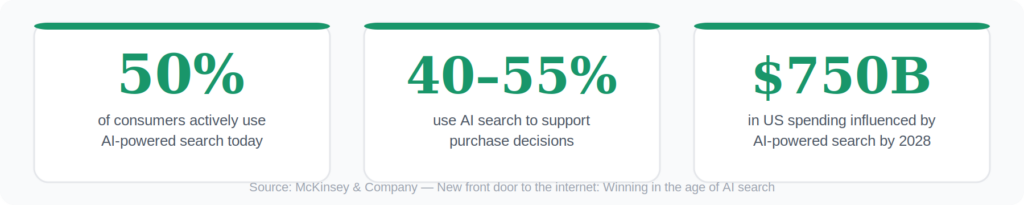
The shift is already visible in consumer behaviour. According to McKinsey, half of consumers now use AI-powered search, and in categories such as travel, wellness, apparel, beauty, consumer electronics, and financial services, 40–55% use it to support purchase decisions.
By 2028, McKinsey estimates that AI-powered search could influence $750 billion in US consumer spending. In other words, GEO is not a future trend to watch. It is a visibility gap businesses need to close now.
AI Search Is Moving Into the Buying Journey
Traditional SEO helps people find your website. GEO asks a sharper question: when AI creates a shortlist, is your business clear, credible, and trusted enough to be included?
“For many companies, GEO is less of a technical SEO problem and more of a trust problem.”
What Makes a Business Worth Recommending?
Behind every AI-generated suggestion is a process of sorting and filtering. AI tools look for signals that help them understand what you offer, whether others can verify it, and how real customers describe your business.
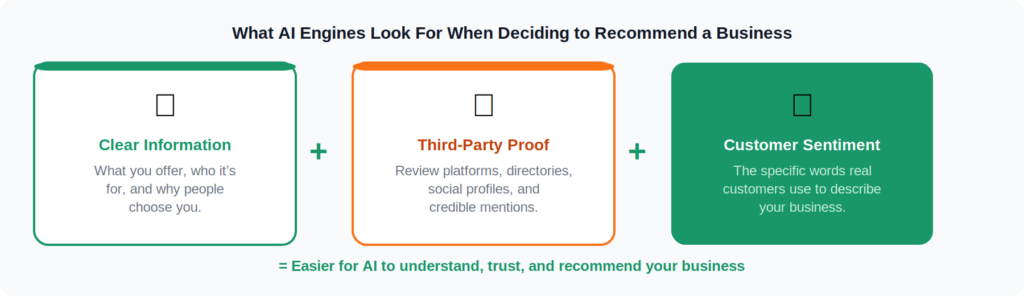
Customer reviews are especially valuable here. They do not just show that people like your business they explain why it is worth recommending. That distinction matters when an AI is writing the answer, not just ranking a list.
Why Some Brands Make the AI Shortlist
When someone asks an AI tool, “What is the best way to display Google reviews on my website?” or “Which review management tool should a small business use?”, the answer is not random.
In simple terms, AI tools interpret the question, look for relevant sources, compare trust signals, and generate an answer that may include specific brands.
Here is the part most businesses get wrong: when AI answers a question about your business, your own website may account for only a small share of the sources it draws on. According to McKinsey, brand-owned websites often make up just 5–10% of those sources. The rest comes from review platforms, editorial content, user-generated communities, affiliate sites, and other third-party mentions — most of which you do not directly control, but can absolutely influence.
Where AI Gets Its Information
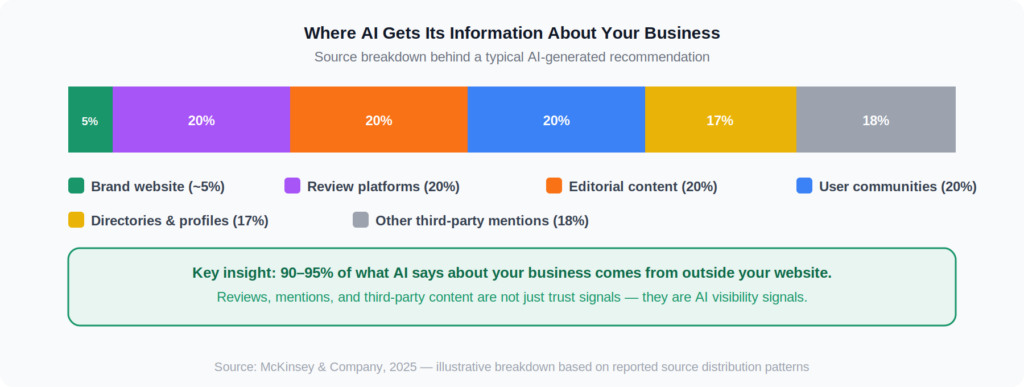
“AI answers are built from the whole web, not just your homepage.”
The Trust Angle: Why Your Reviews Are GEO Fuel
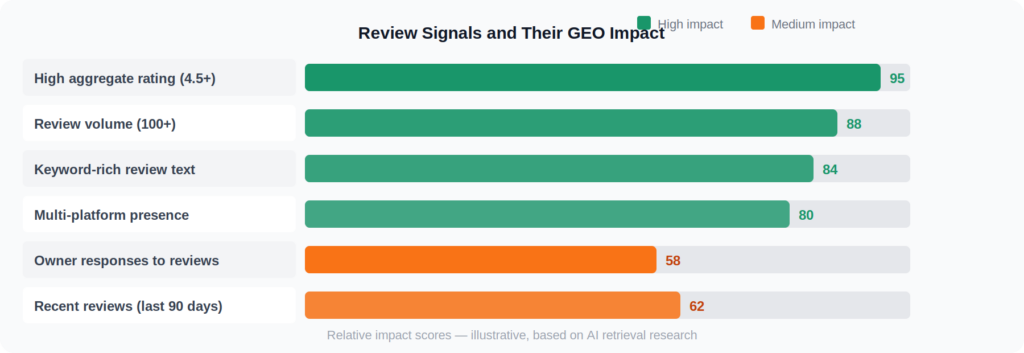
A high rating can catch attention. But the words inside your reviews explain why people choose you.
When a salon is repeatedly described as “great for color correction,” a restaurant as “perfect for date night,” or a skincare product as “worth it for sensitive skin,” those phrases start to shape what the business is known for online.
This is why reviews are valuable for generative engine optimization. They do not just show that customers are satisfied. They create public, specific, human proof around your business.
Your own website can say what you offer. Reviews show how real people experience it. For AI-powered discovery, that difference matters: detailed customer feedback gives AI tools more context to work with, and gives customers more reasons to trust the recommendation.
The Trustindex Advantage in a GEO World
According to McKinsey, only 16% of brands currently track their AI search performance, which means most businesses have no idea whether they are being recommended, ignored, or misrepresented by AI tools.
Trustindex helps close that gap. By collecting, managing, and displaying reviews across 100+ platforms from a single dashboard, it helps businesses build distributed, multi-platform social proof that can support trust across search, review platforms, and AI-powered discovery.
When your rating, reviews, and customer feedback appear consistently across Google, Trustpilot, Facebook, and your own website, your business gives both people and AI-powered tools more public context to work with.
7 Practical GEO Tactics for Any Business
You do not need a huge marketing team to start improving your visibility in AI search. The goal is simple: make your business easier to understand, verify, and recommend.
- Make your offer obvious
Say clearly what you do, who you help, and why people choose you. “We help businesses collect, manage, and display reviews from multiple platforms” beats “we help brands build trust online.” - Put reviews where decisions happen
Show customer feedback on homepages, service pages, product pages, pricing pages, and booking pages not only on a separate testimonials page. - Use specific customer quotes
Generic praise is nice. Specific proof is stronger: “easy to install,” “helped us display Google reviews,” “great for sensitive skin,” “perfect for color correction.” - Keep business information consistent
Name, category, location, services, opening hours, and descriptions should match across your website, Google Business Profile, review platforms, and social profiles. - Answer real buying questions
Create content around what customers actually ask: How can I display Google reviews on my website? Can I collect reviews from multiple platforms? Is it easy to install? What do reviews say? - Build proof beyond your website
Your website is only one part of the picture. Directories, industry blogs, review platforms, and partner pages help build the wider public proof AI tools draw on remember, your own site is just 5–10% of what AI reads. - Track how AI describes you, not just how you rank
Search your business name in ChatGPT, Perplexity, and Google AI Overviews. Note whether you appear and crucially, how you are described.
The Takeaway
GEO is not about chasing AI. It is about creating a clearer, more consistent, more trustworthy online presence one that gives both people and AI-powered tools better reasons to recommend you.
Quick GEO Checklist: Would Your Business Pass?
- Your homepage clearly explains who you serve, what you do, and why customers choose you.
- Your FAQ answers real buying questions, pricing, availability, process, guarantees, or fit.
- Your Google Business Profile is verified, complete, and up to date.
- Your business appears on multiple relevant review platforms with consistent information.
- Your reviews are recent enough to show that your business is active.
- Your reviews mention specific benefits, not only generic praise.
- Your key pages include visible reviews, ratings, or testimonials.
- Your business name, category, location, services, and contact details are consistent online.
- You respond to reviews professionally and regularly.
- Your brand is mentioned beyond your own website in directories, articles, partner pages, or industry platforms.
Quick Win
If most of these boxes are already checked, your business has a strong foundation for GEO. If not, start with reviews they are one of the fastest ways to add fresh, specific, public proof to your online presence.
FAQ: GEO and Reviews
No. A local salon, restaurant, clinic, or service provider with recent, detailed reviews may be easier for AI to recommend than a bigger brand with vague content and weak customer proof.
Search for your brand name directly in tools like ChatGPT, Perplexity, Copilot, or Google AI Overviews. Then ask what a customer would ask “best [service] near me” or “what do customers say about [business name]?” Track not only whether you appear, but how your business is described.
No. GEO builds on SEO. The difference is focus: SEO helps people find your website. GEO helps AI tools understand whether your business is relevant, credible, and worth including in an answer.
There is no guaranteed timeline. Some improvements clearer website copy, stronger FAQs, fresher reviews, more consistent business profiles can help quickly. Other signals take longer to build. Start with the assets you control: your website, reviews, business profiles, and the way customers describe you online.
Start Building Your GEO Foundation Today
Collect, manage, and display customer reviews across 100+ platforms and turn customer feedback into visible trust signals for customers, search engines,
and AI-powered discovery.
900,000+ businesses use Trustindex to collect and embed reviews easily